_edited.png)
More Than Backstory
One of the things I have loved about fantasy my entire life is how quickly it can sweep you away. You open a book, sit at a table, or start a campaign, and the world simply is. Elves exist. Dwarves exist. Goblins lurk in the dark. Dragons soar somewhere beyond the mountains. We jump in and just accept it, and most of the time, that works.
But as a designer, I kept coming back to a different question.
Why?
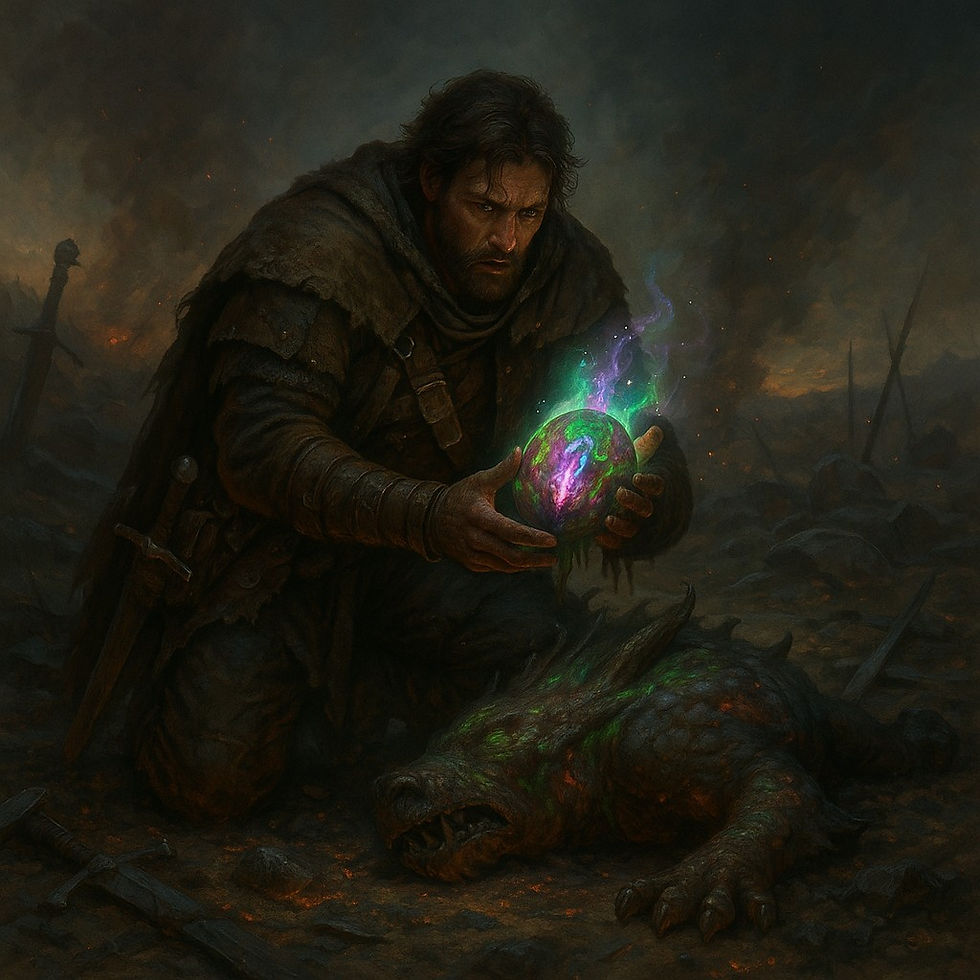
Why do these things exist in this world, specifically? Why are there elves here and not just because fantasy says there should be? Why are there dwarves, dryads, monsters, and creatures of myth? Why does magic feel woven into everyday life? I did not want Shroudwake to begin from the assumption that fantasy tropes simply arrived fully formed. I wanted the world itself to provide the answer. In Shroudwake, that answer is the cataclysmic event known as the Shroudwake, a force of transformation that did not merely damage the world but remade it. It reshaped land, creatures, and people alike. Where there were once only humans, the world now holds elves, dwarves, and other fantastical beings, all born from that original upheaval and its lingering legacy.

What matters just as much is that the Shroudwake was never meant to be a closed chapter in history. It is not a bit of ancient lore tucked safely in the back of the setting. Its influence persists. The world continues to evolve. New mutations still appear. Strange abilities still emerge. The impossible is not ancient history here; it is an active condition of life. That means fantasy in Shroudwake is not decorative. The world looks this way because it was changed, and it continues to change.
That choice shaped the game mechanically just as much as it shaped the lore. From the beginning, I wanted character creation to be more than a single decision made before session one. In a lot of games, building your character is front-loaded. You make the exciting choices up front, then spend the rest of the campaign mostly expressing that first draft. I wanted something different. I wanted players to keep participating in the act of creation throughout the life of the character. In Shroudwake, your early choices matter, but they are only the beginning. Your character continues to evolve through new mutations, branching paths, racial evolutions, symbiotic changes, and legendary outcomes. Character creation is a living process, shaped by adventures, choices, triumphs, failures, and the world itself.
"Character creation happens through the entire life of the character"
This same philosophy also gave me a powerful set of tools as a GM-facing designer. If the world is truly shaped by mutation, then creatures should never feel static either. I did not want encounters in Shroudwake to become predictable just because players recognized the type of enemy in front of them. The same goblins should not always behave the same way. The same predator should not always unfold the same pattern of threat.

This also connects to another principle that mattered to me from the start: player choice should matter, and the story should not feel railroaded. I have long believed that players should be rewarded for innovation, not restricted by systems that funnel them into expected answers. Shroudwake’s evolving world and mutation structure support that by letting both players and GMs react to the story as it unfolds. Progression comes through the shared experience of the adventure, and the game is built to prioritize cooperation, discovery, and meaningful consequences over repetition or static progression loops.
That same design philosophy is why I was willing to do something I find especially exciting: treat death not only as danger, but as transformation.
"Death is not the End"
In Shroudwake, death is still serious. It is still costly. It is still something players should fear. But I did not want death to be meaningful only when it closed the book. In the setting lore, the Shroudwake rewrote the laws of existence so profoundly that death itself became entangled with mutation. In the rules, that becomes the Death Event. When a character is pushed to the brink, their mutation can respond violently, pulling them into torpor, altering them, and returning them changed. Survival leaves a scar. Powers can gain aberrations. Push too far, too often, and you risk becoming Lost entirely. That means death is not trivialized, but neither is it always final. It becomes another place where the story can move the character somewhere new.

For me, that is one of the most important things about Shroudwake as a setting and as a game. The world’s central event is not just backstory. It is the reason the setting exists in the form it does. It explains why fantasy peoples and creatures are here. It explains why the world feels unstable, wondrous, and dangerous. It explains why your character can keep changing over time. It explains why creatures stay surprising. It explains why even death can become part of a character’s evolution rather than merely the end of their usefulness in the story.
Shroudwake is, at its heart, a game about identity, adaptation, and transformation in a world where myth has an origin and change has consequences. I did not want to make a world where fantasy simply existed because tradition expected it to. I wanted to make a world where fantasy has a reason for being, and everything beautiful, terrible, and legendary grew out of it.


Comments