_edited.png)
The Writ system at the heart of Shroudwake
In the many TTRPG systems I've played in, progression tends to live separate from the story. You defeat enemies, gain experience, collect treasure, and eventually level up. The adventure is there, but the mechanics that drive character growth often sit beside it.
Shroudwake was built to do something different.
The Writ system is not just how adventures are organized. It is how the game handles progression, pacing, recovery, rewards, and consequence. Writs are not quests with a new label. They are the structure that ties the story at the table directly to how your characters grow and how the world moves around them.
A Writ Is More Than a Mission
A Writ is designed to be more than a mission objective or a loose adventure hook. In Shroudwake, a Writ is meant to carry the weight of a full chapter of story, usually built to unfold over a typical four-hour session. It gives the party a clear objective, real stakes, and a reason to move forward together.
It is not just a sequence of encounters. It has shape. It has momentum. It has a sense of purpose. Players are not wandering until something happens. They are pursuing something that really matters, and the mechanics of the game are built to reinforce that feeling.
For Game Masters, this also creates a cleaner framework to build around. A Writ gives you a natural beginning, escalation, and payoff without forcing the adventure into a rigid track. The players still have freedom in how they solve problems, but the session has a strong spine running through it.
This is one of the reasons Writs work so well for both home games and organized play. They have enough shape to provide consistency, but enough openness to let different groups solve the same problems in wildly different ways.

Writ Milestones Create Momentum
Inside each Writ are Writ Milestones, and they are one of the most important pieces of the system.
A milestone marks meaningful progress. The party has uncovered something important, overcome a major obstacle, or pushed the story into its next phase. When that happens, the game responds with a Restore Action. Players recover health, refresh mutation uses, and the party gains an Adventure Point, a micro-currency the players share that allow them to perform unique feats.
This creates a very different rhythm from games that rely entirely on long rests or vague downtime.
In Shroudwake, recovery is tied to momentum. You earn breathing room by pushing deeper into the story. The party is rewarded for advancing the Writ, not for trying to stall the action or retreat every time pressure starts to build. That gives the game a strong pace. Tension rises between milestones, then releases when the party reaches one.
Progression comes from adventure, not grinding
One of the clearest ways the Writ system defines Shroudwake is in how leveling works.
Characters advance every four completed Writs, regardless of whether each one ended in perfect success or painful failure.
That choice says a lot about what the game values.
Shroudwake is not built around kill counts. It is not built around farming encounters for experience. It is built around shared adventure. If your party pushed through a dangerous mission, made difficult choices, suffered consequences, and carried the story forward, that experience matters. Even failure can reshape the world, reshape the party, and reshape the characters themselves. It still counts.
Players are encouraged to ask, “What do we do next?” rather than “What gets us the most XP?”
That shift is one of the biggest design goals behind the game.
Writs reinforce cooperative play
From early on, one of the major goals behind Shroudwake was to better incentivize cooperation.
Too many systems reward behavior that can pull players away from the shared story. When progression is tied too tightly to combat or individual optimization, it can quietly push the party toward choices that are not actually best for the group or the narrative.
The Writ system helps solve that.
Because progression is tied to completing adventures, not simply defeating enemies, the focus stays on the party’s shared objective. Players are rewarded for solving the problem in front of them, whatever form that solution takes. Combat is still exciting and important, but it is no longer the only thing the game mechanically validates.
That supports the kind of play Shroudwake is built for: collaborative, story-driven, and responsive to player choice.
Success still matters
A system that values the journey should not make success feel meaningless, and Shroudwake does not.
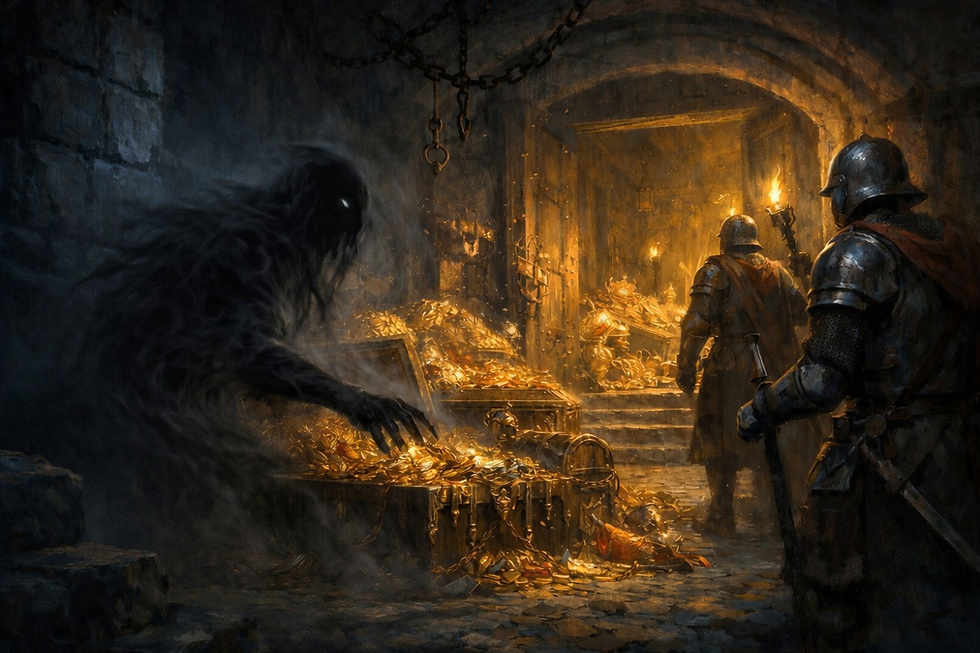
Each Writ comes with its own reward sheet. Successful completion grants access to the unique rewards tied to that specific adventure. Even if the party fails, they still receive the sheet, preserving continuity and showing what was at stake, but the best rewards still have to be earned.
That balance is important.
Failure does not dead-end progression, but success still feels significant. The game continues moving either way, yet outcomes still matter. This is part of the larger philosophy behind Shroudwake: the story should respond to what happened, not collapse because things did not go perfectly.
Writs measure time in the world
Another thing that makes the system work so well is that Writs are not only adventure structures. They are also measures of time.
Crafting, progression, and certain longer processes are tracked in Writs. That means time in the game is grounded in lived adventure. The world moves because the party has moved through meaningful chapters of action, not because someone marked off a few abstract days on a calendar.
It is a small design choice with a big payoff. It helps the world feel connected to what the players are actually doing at the table.
The heart of shroudwake
At its core, the Writ system exists to support a certain kind of play.
It supports play where the party works together. It supports play where story and mechanics reinforce each other. It supports play where failure changes the world instead of stopping it. It supports play where progression comes from experience in the truest sense, not from repetition.
Most of all, it supports the broader vision of Shroudwake itself: a game about change, adaptation, consequence, and the feeling that your characters are being shaped by the adventures they survive. In the wider language of the setting and brand, Shroudwake is built around transformation, cooperation, and meaningful character evolution. The Writ system is one of the clearest mechanical expressions of that promise.


Comments